This article contains affiliate links. I may earn a commission at no added cost to you.
⚡ QUICK VERDICT
Excellent choice for: Xbox or PC players who want drift-free sticks and competitive polling rate without paying premium-controller prices
Main strength: TMR sticks and Hall Effect triggers eliminate drift and maintain consistent performance
Main drawback: Xbox players are limited to a wired connection
Rating: 9/10
Scored on drift resistance, trigger feel, polling rate, and value. Loses a point for wired-only Xbox play.
Over about seven years I went through five premium controllers chasing one that wouldn’t drift. One original Xbox Elite. Then two Elite Series 2s. Then two Scuf Instinct Pros. Every one of them eventually developed stick drift, so I kept buying replacements. I finally switched to the GameSir G7 Pro six months ago. It costs a fraction of what any of those did, and so far it’s the only one that hasn’t failed me. Here’s the honest comparison.
My controller history, and why it matters here
I’m not comparing these from a spec sheet. I owned the original Xbox Elite for about a year before it drifted. I moved to the Elite Series 2 and went through two of them over about two years, same drift problem each time. Then I switched to Scuf and owned two Scuf Instinct Pros over about four years, the first lasted around two and a half years before drift set in, the second about a year and a half. Five premium controllers, and every single one eventually drifted. That’s the context for why an $80-range controller with magnetic sticks got my attention.
The stick drift problem this controller solves
Every standard controller, including the Xbox Elite series and the Scuf Instinct, uses potentiometer-based analog sticks. These are physical contact sensors that wear down over time, eventually causing stick drift, where your character moves or your aim drifts without any input from you. It’s one of the most common and frustrating controller failures, and based on my own history with five premium controllers, it’s essentially guaranteed to happen eventually on any traditional stick design. With my controllers it was never a question of if, only when.
The G7 Pro uses TMR (Tunnel Magnetoresistance) sticks instead. These work on magnetic field detection rather than physical contact, meaning there’s no mechanical wear surface to degrade. No wear means no drift. After six months of daily use across Apex Legends and Arc Raiders sessions, the sticks feel exactly the same as day one. Zero drift. I want to be precise here: six months is a good start but shorter than the years my Scufs lasted before failing, so I can’t yet call it proven for the long haul. What I can say is that the TMR design removes the exact mechanical wear point that drifted every controller before it. After replacing five controllers for exactly this problem, that’s the single biggest reason I’d point anyone toward this over an Elite.
Hall Effect triggers
The triggers use Hall Effect technology, the same magnetic principle as the TMR sticks. Standard triggers use physical potentiometers that develop dead zones and inconsistent pull weight over time. Hall Effect triggers maintain consistent feel and response throughout their lifespan. Combined with the 1000Hz polling rate, inputs register faster and more accurately than on any controller I’ve used at any price point. In something like Apex where trigger timing matters, the difference is noticeable.
Grip and feel vs the Elite and Scuf
The premium in-hand feel was the thing I actually liked about the Elite, so this mattered to me. The good news is the G7 Pro holds up. I prefer the rubber grip and feel of the Elite and the G7 Pro over the Scuf, the Scufs never felt quite as good to hold as either. So the G7 Pro matches the premium grip feel that made me like the Elite in the first place, which is worth knowing if you’re worried a cheaper controller feels cheap. It doesn’t. Everything also feels crisper than the Elite controllers. Face buttons have a satisfying tactile response without being mushy or requiring excessive travel, and the triggers have a precise, consistent pull that holds up session after session. Coming from the Elite Series 2, which I always felt was slightly overrated for the price, the G7 Pro’s button feel is a genuine step up, not a compromise.
1000Hz polling rate
Most controllers poll at 125Hz or 250Hz, meaning they report input to your system 125 or 250 times per second. The G7 Pro polls at 1000Hz. At 1000Hz, your inputs are registered up to 8 times faster than a standard controller. In competitive play this translates to reduced input lag and more precise timing on fast actions. Whether you’ll feel it depends on your skill level and the games you play, but in Apex Legends where frame timing matters, it’s a real advantage.
The white colorway and build
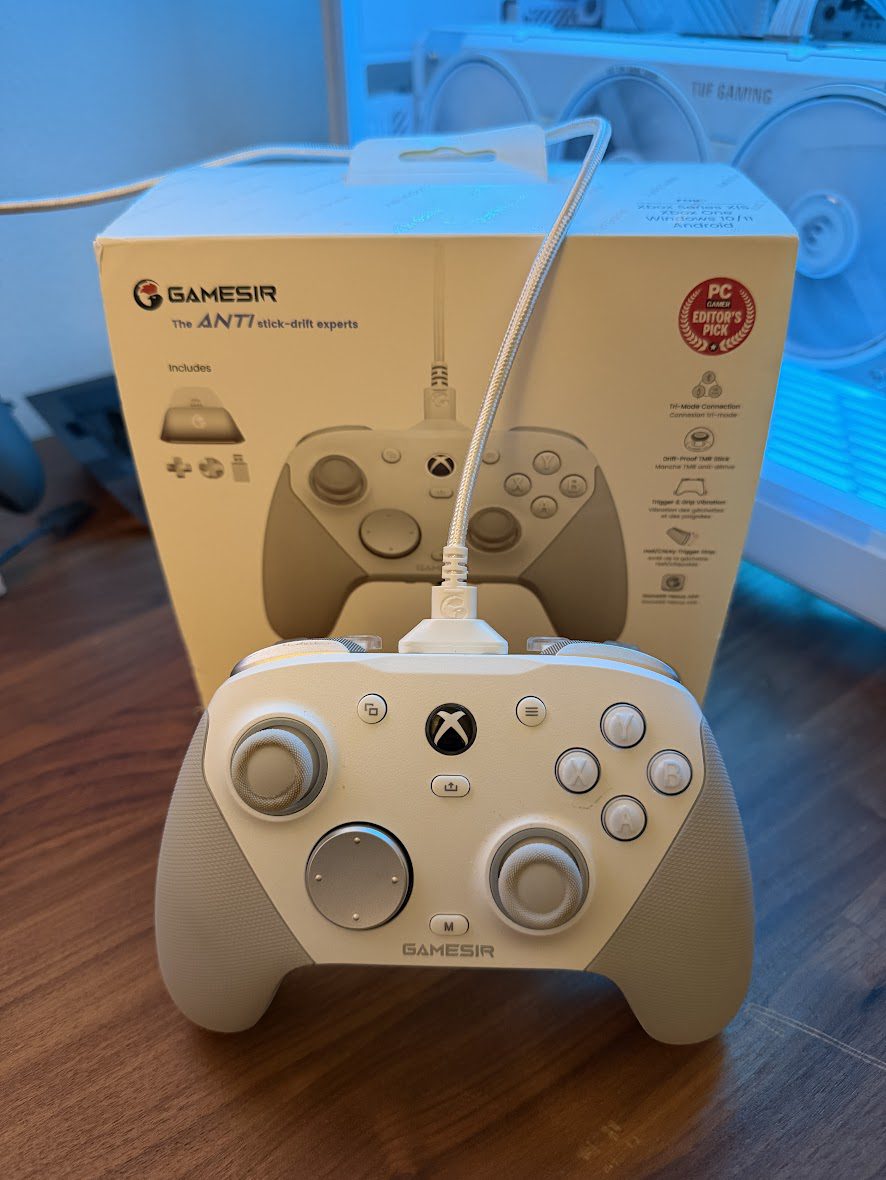
I picked up the white version, which pairs cleanly with my white PC build. Build quality feels premium for the price. Nothing flexes, rattles, or feels hollow. The grip texture is comfortable over long sessions without being aggressively rubberized in a way that wears on your hands. I’m also running the LG 27U631A-B as a second monitor on the same desk, and the white G7 Pro pairs well with that setup.
Compatibility
Works on Xbox Series X/S, Xbox One, PC, and Android. The 3.5mm audio jack means you can plug headphones directly into the controller, which is a feature the base Xbox controller skips on some models. Officially Xbox-licensed, so no compatibility concerns on console.
Where the Elite still wins: wireless and paddles
The G7 Pro does not support wireless play on Xbox. Xbox connections require the included USB cable. Its 2.4 GHz wireless mode works with PC, while Bluetooth is intended for Android devices. I game on PC and I’ve used it both wired and wireless, but I prefer wired anyway so I never have to think about charging, so this limitation hasn’t affected me. If you need wireless on console, though, the Elite Series 2 still has that on the G7 Pro. The Elite also has full swappable paddles and thumbstick toppers, which the G7 Pro’s smaller rear buttons don’t fully match. If deep physical customization matters to you, that’s the Elite’s remaining edge.
The price comparison that matters
The Elite Series 2 sits at the top of Xbox’s controller lineup on price. The Scuf Instinct is in similar territory. The G7 Pro costs a fraction of either. Check the current price on Amazon, but the gap is large enough that the G7 Pro would have to be much worse to justify the difference. In the areas that affect daily play, drift-free sticks, trigger consistency, and polling rate, it isn’t worse. And factoring in the replacement controllers I bought over the years, the G7 Pro has already saved me far more than its purchase price.
Specifications
| Model | GameSir G7 Pro |
| Price | Check current price on Amazon |
| Compatibility | Xbox Series X/S, Xbox One, PC, Android |
| Analog sticks | TMR (Tunnel Magnetoresistance) |
| Triggers | Hall Effect |
| Polling rate | 1000Hz |
| Audio | 3.5mm headphone jack |
| License | Officially Xbox licensed |
| Colorways | White, Black |
Pros and cons
✅ Pros
- TMR sticks designed to eliminate drift
- Hall Effect triggers maintain consistent pull weight
- 1000Hz polling rate
- Grip and button feel match the premium Elite and beat the Scuf
- Officially Xbox licensed for full compatibility
- 3.5mm audio jack
- Costs a fraction of a premium Elite or Scuf
❌ Cons
- Wireless play is not supported on Xbox. Xbox users must connect with the included USB cable
- The rear buttons are smaller and less prominent than the removable paddles found on Xbox Elite and Scuf controllers
- Less brand recognition than Elite or Scuf
- Some features, including wireless connectivity, gyro controls, and the 1000Hz polling rate, vary by platform
Who should buy each
Buy the Elite Series 2 if you need wireless on Xbox, want swappable paddles and thumbstick toppers, and you’re willing to accept that potentiometer sticks can drift over time. Buy the G7 Pro if you play wired or on PC, want sticks that shouldn’t drift, and don’t want to pay premium-controller prices to get there. For me, after five controllers that drifted, the choice was easy.
Verdict
I went through five premium controllers before this one, one Elite, two Elite Series 2s, and two Scuf Instinct Pros, and every one eventually drifted. The GameSir G7 Pro is the first that hasn’t. TMR sticks designed not to drift, Hall Effect triggers that stay consistent, a 1000Hz polling rate, and grip and button feel that match controllers costing far more. Six months in it’s been flawless, and while that’s not yet a multi-year track record, the TMR design removes the exact wear point that killed every controller before it. If you’re weighing an Elite Series 2 upgrade or you’re tired of replacing drifting controllers, buy this instead. The only real reason to choose the Elite is if you need wireless on Xbox or you rely on its full paddle customization.